hiTRAN® Thermal Systems
Enhancement technology for tubular heat exchangers and reactors.
hiTRAN® Thermal Systems are an established, unique solution to substantially enhance the tube side heat transfer by changing fluid dynamics. Installed in more than 20, 000 exchangers worldwide over 40 years, a wide range of case studies are a testament to the benefits of hiTRAN
hiTRAN® Thermal Systems
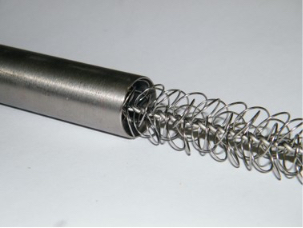
hiTRAN Thermal Systems incorporate a wire matrix element (turbulators), purpose-designed and easily installed to offer the most significant benefit for laminar and transitional flow regimes.
The tube side heat transfer coefficient can be increased up to 16x, dependent upon Reynolds number and hiTRAN geometry. Applications in both single and two-phase flow are possible, including high and low viscosity fluids. For new exchangers installation is completed after fabrication and can easily be retrofitted to debottleneck existing equipment too.
The System comprises of a wide variety of geometries that can be selected to meet a broad range of requirements and conditions, allowing a wide scope of processes to benefit. Payback is usually rapid making ownership an affordable investment.
hiTRAN Thermal Systems are shipped worldwide from our UK based design and manufacturing facility. Where design is supported by years of research and performance feedback, enabling CALGAVIN® to offer unique performance warranty. Our integrated design and manufacturing process operate in accordance with ISO9001 to ensure the highest quality products and reliability.
To know more about hiTRAN’s features and benefits, please follow the single and two-phase overview links on the left.
Frequently asked questions
Can I re-use hiTRAN® Thermal Systems?
Provided the correct removal procedure is followed and the elements are handled and stored carefully; they can be reinstalled into the same exchanger. Where a bundle or tubes are replaced, differences in tube tolerances may cause a poor fit. For such tubes replacement, re-supply of hiTRAN is recommended.
Can hiTRAN® be designed to meet my process requirements and application specifications?
hiTRAN has a large degree of flexibility in design geometry, which provides variable heat transfer and pressure drop characteristics. This flexibility is incorporated into our CALGAVIN.SP plug-in, which enables the user to assess designs based on defined allowable tube side pressure drop. The CALGAVIN.SP (hiTRAN.SP in standalone version)
algorithm will revert to the lowest pressure drop or highest enhancement geometry, respectively, for the given conditions, where the allowable pressure drop is either too low or higher than required. This provides the designer with the necessary software tool to find the optimum solution.
What materials can hiTRAN® Thermal Systems be manufactured from?
hiTRAN Thermal Systems can be manufactured from most material that can be sourced in wire form. hiTRAN is most often manufactured from the same material as the heat exchanger tubes to prevent any possibility of galvanic corrosion happening. The most common material selections tend to be stainless steels, however, special alloys and exotic materials such as Hastelloy®, tantalum and even silver have been supplied.
Can hiTRAN® Thermal Systems be fitted as a partial installation in a portion of the tube?
CALGAVIN engineers will look at all options to provide the most effective solution to your problem, including installation in only one or some tube passes or part of the tube length. Likewise, suitable installation and retention systems are available for these options.
Can hiTRAN® be retrofitted to existing air cooled exchangers?
Thermally and hydrodynamically the suitability of an air cooler for improvement with hiTRAN is no different than a shell and tube. However, retrofitting with hiTRAN may require modification of the pass arrangement, and with air cooler headers, other than cover plate type, this can be difficult, such that, replacement is more practical. This has been done in cases where the benefit is very large.
Are hiTRAN® Thermal Systems supplied as a stock item or is it custom designed for each order?
hiTRAN Thermal Systems are custom designed and manufactured based on process analysis, using the CALGAVIN.SP plug-in, considering thermal performance and pressure drop implications. CALGAVIN can support clients in optimising designs allowing hiTRAN to solve a greater range of problems.
Can hiTRAN® Thermal Systems be fitted in a U-tube bundle?
Installation in U-tubes results in reversing the fitting direction in one leg and requiring a lesser interference fit. Modified performance is taken into account in the calculations where U-tube is specified. Alternate installation and retention options are required, and instructions are provided in our Installation Manual and on-site assistance can be provided.
In what applications are hiTRAN® Thermal Systems not appropriate?
Benefits from enhancing performance with hiTRAN are greatest when the tube-side co-efficient is substantially controlling (very low). This benefit reduces as the tube-side co-efficient approaches equality with the outside co-efficient at which point little overall enhancement is achieved. By example, applications, where enhancement will not provide a benefit, include :- where the outside co-efficient is very low or where, on the tube-side, there is a high co-efficient like steam or other condensing fluid.
What is the advantage of using hiTRAN® Thermal Systems versus Twisted Tape type turbulators?
The enhancement mechanisms are different between these turbulator types and this leads to markedly better performance by hiTRAN in the laminar and transitional flow regimes. hiTRAN can still offer higher heat transfer rates in turbulent flow, but lower pressure drop offered by twisted tapes means it can be a good option at high Reynolds numbers.
What considerations need to be taken when applying hiTRAN® to fouling process fluids?
Fouling is a complex issue with many different types and mechanisms. The enhancement effect hiTRAN has on flow inside tubes can be beneficial for some types of fouling, thereby providing a mitigation process. In practice, detailed information about the mechanisms is rarely available, such that a fouling reduction benefit cannot be easily calculated or guaranteed. Therefore, heavily fouling services need to assume that periodic cleaning will be required. As with empty tubes, it is important to monitor the exchanger performance to avoid excessive foulant build-up. While chemical cleaning options can be carried out with hiTRAN in-situ, mechanical cleaning methods require removal of hiTRAN before cleaning. Following the installation and removal procedures, including safe storage of the hiTRAN while cleaning, allows for reuse of the hiTRAN. Some spares would be advisable.
What are the minimum and maximum tube diameters hiTRAN® can be manufactured for?
The smallest tube diameter hiTRAN can be designed for is 6mm and the range extends up to 150mm.
Are hiTRAN® Thermal Systems warrantied?
CALGAVIN® warrants both thermal and hydraulic calculations provided directly or via the CALGAVIN.SP plug-in, based on customer data and design conditions, for clean recirculating fluids. In cases where uncertainties exist and for fouling applications, additional advice regarding expected performance may be provided.