


Design-Stage Thermal Enhancement 77% Heat Exchanger Size Reduction
The Challenge:
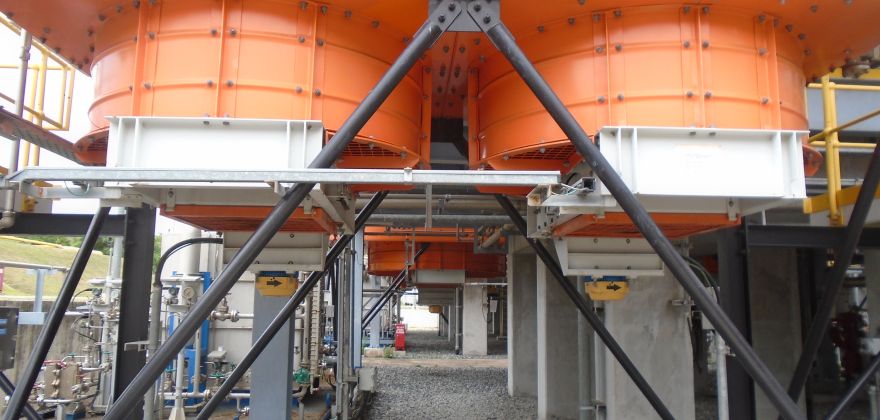
CALGAVIN’s primary technology hiTRAN® Thermal Systems, a tube side heat transfer enhancement product for industrial heat exchangers, has been used to optimise new designs for primarily utility heat exchangers, e.g. compressor lube oil air coolers, since 1980. The hiTRAN product has also been retrofitted to key process heat exchangers, giving the benefit of reduced capital costs and removing the need to replace underperforming units. In order to deliver a compact air-cooled heat exchanger system for a compressor lubricating oil service in Thailand, whilst meeting strict plot space constraints and ensuring long-term thermal reliability, the contractor required a high-duty lubricant cooler within a limited footprint. Conventional empty-tube air cooler designs would have required approximately 4.3–4.5 times more heat transfer surface area to achieve the same thermal duty and design margin, making the layout impractical within the available space. At the design stage, CALGAVIN’s hiTRAN thermal systems were specified and installed from initial fabrication across four separate air coolers.
Want to know more? Read the full Case Study here.
The Solution:
The results of the hiTRAN inserts enabled a significant reduction in required heat transfer area, as well as compact Finfan configuration within plot limits and full thermal duty with maintained design margin. In order to support the long-term lubricant stability, oil samples were collected and analysed by an independent third-party laboratory to monitor condition parameters including oxidation indicators, viscosity retention, and overall lubricant health. The consistent laboratory results indicate that operating temperature remained stable and controlled within acceptable limits, significantly reducing thermal stress and oxidation progression. While mineral turbine oils are designed with oxidation resistance additives, service duration strongly suggests that effective heat removal at the cooling stage has played a critical role in preserving lubricant integrity, requiring minimal filtration intervention, no oil changes and no oil top-ups. Overall, this demonstrates how the design stage thermal enhancement can deliver measurable engineering impact, focusing on long-term lubricant preservation and thermal optimisation which not only improves heat transfer performance, but it also directly supports operational reliability and sustainability across the full lifecycle of rotating machinery systems.